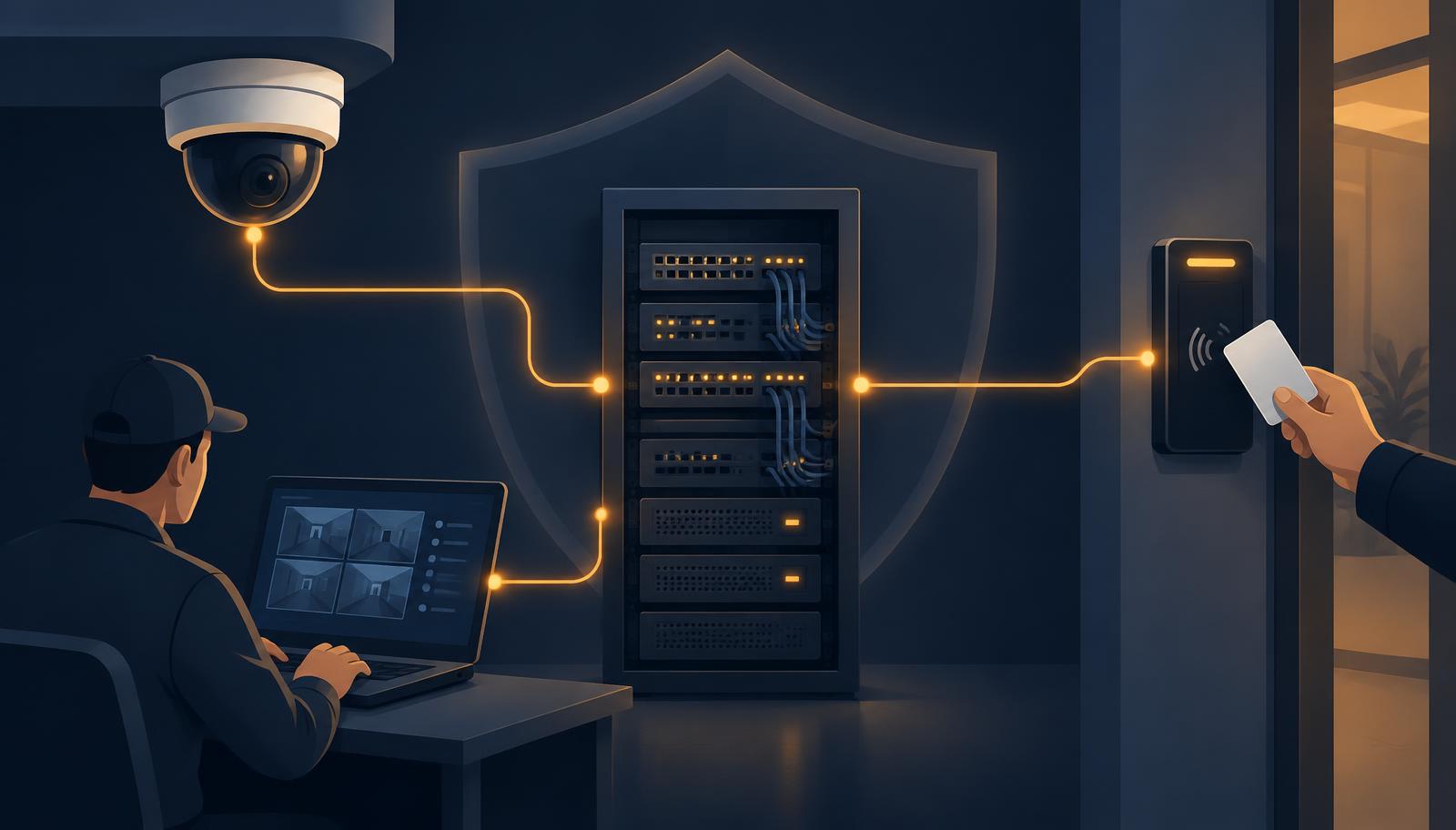

A distribution center discovers that a controlled-access door remained unlocked overnight. Thieves enter the building and remove $420,000 of electronics. The facility owner claims the access-control contractor programmed the schedule incorrectly, failed to test the system, and did not catch the problem during commissioning.
The contractor reports the claim under its general liability policy and assumes the insurer will handle it. Then the coverage questions begin.
- Was there property damage caused by the contractor's work?
- Was the claim based on negligent installation, faulty programming, failure of the system to perform, or breach of contract?
- Does the general liability policy contain a security-system or failure-to-perform exclusion?
- Does the contractor's E&O policy cover physical property damage, or only financial loss?
The answer may depend on a few paragraphs buried deep in the policies. That is the problem.
Low-voltage contractors perform physical work, but they also provide technical judgment, system design, programming, configuration, testing, and integration. Their claims do not always fit cleanly into a traditional contractor's general liability policy.
The basic difference between GL and E&O
The common explanation goes something like this:
- General liability covers bodily injury and property damage.
- Errors and omissions covers mistakes in professional services.
That is a useful starting point, but it is not enough to determine how a real claim will be handled. A lawsuit rarely arrives with a label telling the insurer which policy should pay. It contains allegations. Those allegations may involve physical work, technical services, contractual promises, system performance, financial damages, or several of these at once. The policy language must then be matched against the allegations.
What general liability is designed to cover
Commercial general liability insurance is primarily designed to address claims involving third-party bodily injury, property damage, and certain personal or advertising injuries. For a low-voltage contractor, potential GL claims may include:
- A technician damages a customer's finished wall while pulling cable.
- An improperly secured camera falls and injures a passerby.
- A ladder left in a corridor causes a slip-and-fall.
- A subcontractor's van backs into a bollard at a customer's loading dock.
These are physical events tied to the contractor's operations, and they are the kind of loss GL is built to handle. Where GL becomes uncertain is when the allegation is not really about physical damage from the work itself, but about the system not performing as it was intended.
What E&O is designed to cover
A professional liability or technology errors-and-omissions policy is written for the judgment side of the work: how a system is designed, specified, programmed, configured, integrated, tested, monitored, or advised on. Depending on the form, an E&O policy for a low-voltage contractor may respond to allegations that:
- A camera layout left a portion of a covered area unmonitored.
- An access-control schedule was programmed incorrectly.
- A fire alarm device was placed against code.
- An integration did not communicate with a customer's network the way the proposal described.
- Monitoring services were not delivered as promised.
E&O forms vary widely. Two policies with the same name can respond very differently to the same claim, especially when the loss involves physical property damage rather than pure financial loss.
Where GL and E&O overlap, and where they don't
The hard cases are the ones that touch both worlds. A real low-voltage claim often involves technical services that caused, or failed to prevent, a physical loss. GL may deny because the allegation is about the system's failure to perform. E&O may deny because the resulting loss is physical property damage, which some E&O forms exclude or sub-limit. Both insurers may reserve rights while the wording is analyzed.
Why the policy language matters more than the label
A carrier does not read the certificate of insurance when deciding a claim. It reads the policy form, endorsements, and definitions. Two contractors can hold policies from the same carrier under the same product name, and still have materially different coverage because of endorsements added, removed, or modified at the underwriting stage.
The definitions that tend to control the outcome for this trade include:
- How the policy defines professional services.
- Whether bodily injury and property damage arising out of a professional service are covered under GL, excluded, or moved to E&O.
- Whether the E&O form is written on a claims-made or occurrence basis, and how the retroactive date is set.
- Whether defense costs sit inside the E&O policy limit or outside it.
- How the policy treats breach of contract, warranty, and guarantee allegations.
Questions to raise at the next insurance review
A useful review should produce clear answers to the following questions:
The better approach
General liability and E&O should be reviewed as parts of one insurance program. The review should begin with the contractor's actual work: what the company designs, installs, configures, monitors, manages, and promises in its contracts. From there, the policy language can be tested against realistic claim scenarios.
That process is more useful than checking boxes on an application or buying an inexpensive E&O policy because a general contractor requested a certificate. The objective is not to predict exactly how every claim will be handled. No one can do that without the allegations, facts, and issued policy forms. The objective is to identify obvious conflicts before a failed system, customer lawsuit, or reservation-of-rights letter exposes them.
Request a low-voltage coverage review
Low Voltage Insurance helps alarm contractors, security integrators, structured-cabling companies, AV integrators, fire alarm contractors, and related technology businesses review how their GL, E&O, cyber, auto, workers' compensation, inland marine, and umbrella policies fit together. Our coverages and services overview shows how a specialist structures the program as a company scales, and the Resource Center will continue to add guidance on the coverage questions we hear most often.
A coverage review can include:
- Review of current policy structure and major exclusions
- Comparison against the company's actual services
- Evaluation of contract insurance requirements
- Identification of potential gaps between GL, E&O, and cyber
- Recommendations for the next renewal or marketing process
Ready to talk it through? Reach our team through the contact form and we will set up a review that fits your operation.
Coverage depends on the language of the issued policies and the facts of each claim. This article provides general information and is not a binder, quotation, coverage opinion, or insurance contract.