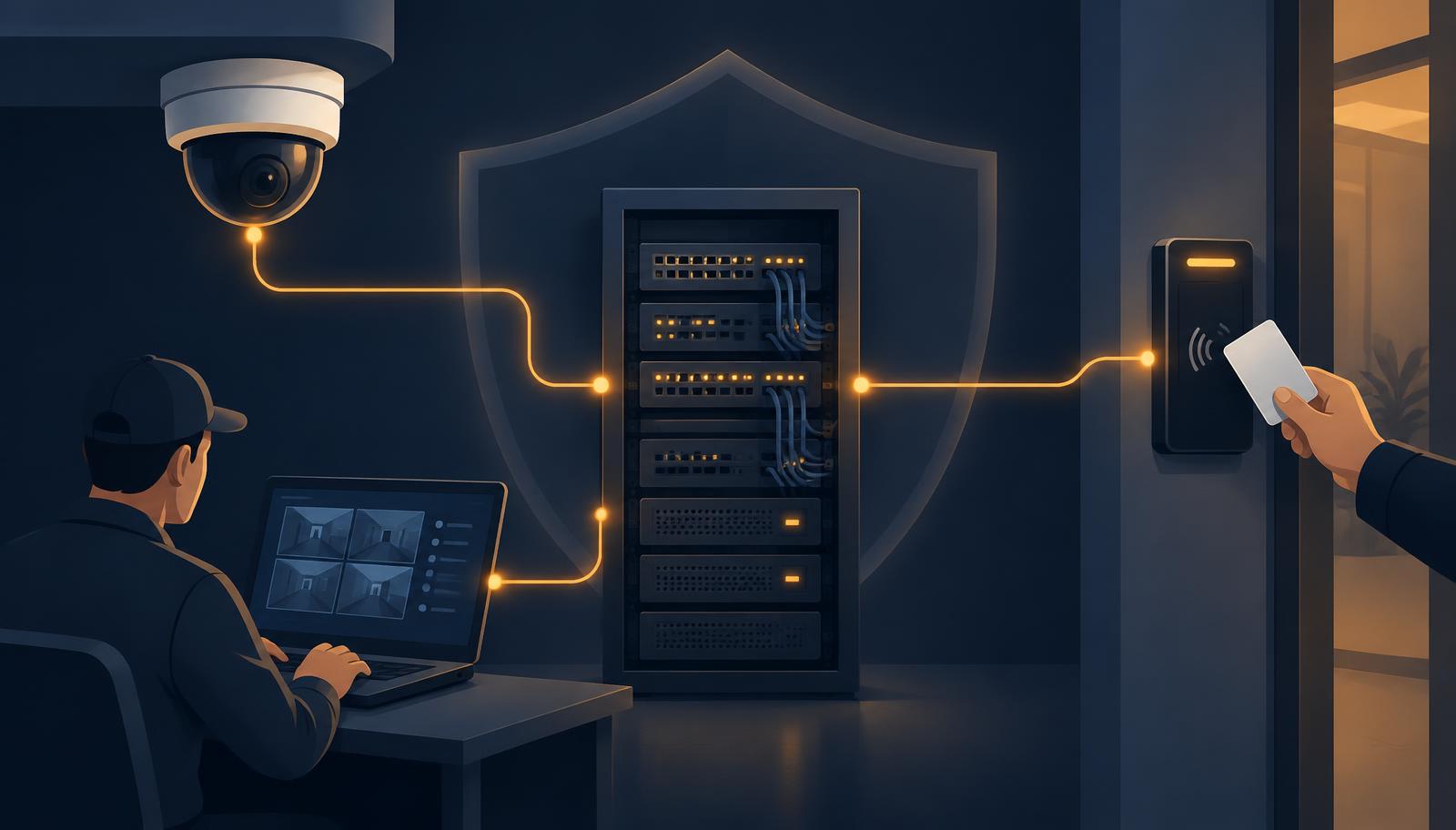

A security integrator orders cameras, card readers, control panels, network switches, cable, and related equipment for a large commercial installation.
The equipment is worth $94,000.
Some of it is stored at the contractor's shop. The rest is loaded into a locked job trailer and delivered to the project site two days before installation begins. Overnight, thieves cut the trailer lock and remove most of the equipment.
The contractor assumes the tools and equipment policy will cover the loss. After all, the company purchased inland marine insurance and the stolen property was going to be used on a job.
Then the distinction becomes clear.
The tools policy covers the drills, testers, ladders, lifts, and other equipment the contractor uses to perform the work. It may not cover cameras, panels, cable, and customer-destined equipment that will become a permanent part of the completed system.
The general liability policy is not designed to replace the contractor's own stolen materials. The building owner's builders risk policy may or may not include the subcontractor's property and financial interest.
Why this gap is easy to miss
Low-voltage contractors transport two very different types of property.
The first category is the equipment used to perform the work:
- Power tools
- Cable testers
- Ladders and lifts
- Fusion splicers
- Labeling equipment
- Laptops and tablets
- Hand tools
- Diagnostic equipment
The second category is the property being installed for the customer:
- Security cameras
- NVRs and recording equipment
- Access-control panels
- Card readers and credentials
- Intrusion and fire-alarm devices
- Reels of copper and fiber cable
- Racks, switches, and power supplies
- Speakers, displays, and AV equipment
- Sensors, controllers, and related components
Those categories can sit next to each other in the same van, warehouse, trailer, or job site. They are not necessarily insured the same way.
A contractor may have $75,000 of tools and equipment coverage and still have little or no protection for $150,000 of materials awaiting installation.
The policy name alone does not answer the question. The covered-property definition does.
What is an installation floater?
An installation floater is a form of inland marine insurance designed to cover materials, supplies, fixtures, machinery, and equipment that a contractor is responsible for installing.
Depending on the policy, coverage may follow the property through several stages:
- Leaving the supplier or contractor's premises
- Traveling to the project
- Temporary storage away from the job site
- Delivery to the project site
- Installation
- Testing and commissioning
- Completion and acceptance
The coverage period does not continue forever. An installation floater commonly ends at a defined point, such as when the property is installed, accepted by the owner, put to its intended use, or when the contractor's interest in the property ends.
That endpoint must be reviewed in the actual policy.
Low-voltage projects do not always have a clean handoff. A system may be physically installed but not yet programmed. It may be programmed but not yet tested. The owner may begin using part of the system while punch-list work remains.
The policy needs to fit that timeline.
Installation floater vs. tools and equipment coverage
Tools and equipment coverage generally protects property the contractor uses repeatedly to perform its work.
An installation floater generally protects property intended to become part of the customer's finished project.
- A cable tester is a tool.
- A reel of Cat6 cable that will remain in the building is installation material.
- A portable lift is equipment.
- A control panel that will be mounted, wired, programmed, and transferred to the customer is installed property.
A contractor-owned laptop used to configure a system may fall under an equipment, computer, or electronic-data-processing form. A server or network switch being supplied and permanently installed for the customer may belong under the installation floater.
The distinction sounds simple until a claim involves multiple categories of property. That is why the schedule, definitions, and valuation provisions need to be reviewed before a loss.
Does the general contractor's builders risk policy cover it?
Possibly. Do not assume that it does.
Builders risk commonly protects property involved in a construction project, including materials that will become part of the completed structure. Depending on the policy and contract, subcontractors may be included as insureds or their interests may be protected.
There are still questions to resolve:
- Is the subcontractor included as an insured?
- Does coverage apply to property in transit?
- Is off-site storage included?
- Are low-voltage systems and electronic equipment covered?
- Is there a sublimit for property away from the project?
- Who controls the claim and deductible?
- When does coverage begin and end?
- Does the policy cover testing and commissioning?
- Is the subcontractor required to carry its own installation floater?
A certificate of insurance showing that builders risk exists is not enough. The certificate does not explain whose property is covered, where it is covered, or what exclusions apply.
The construction contract and builders risk policy should be reviewed together.
A subcontractor may still carry an installation floater even when builders risk is provided by the owner or general contractor. The objective is not to create unnecessary duplicate coverage. It is to know which policy is supposed to respond and whether the contractor's financial interest is protected throughout the project.
What property should a low-voltage installation floater include?
The answer depends on the contractor's operations, but the review should consider any property the company supplies and installs.
Alarm and security contractors
- Intrusion panels
- Motion detectors
- Door contacts
- Sirens and notification devices
- Cameras and recording equipment
- Access-control panels
- Readers, locks, and intercom components
Structured-cabling contractors
- Copper and fiber cable
- Patch panels
- Racks and cabinets
- Jacks, faceplates, and connectors
- Network switches supplied under the contract
- Cable-management components
AV integrators
- Displays and projectors
- Speakers and amplifiers
- Control systems
- Video-conferencing equipment
- Digital-signage components
- Mounting hardware and racks
The values can accumulate quickly.
One individual camera may not create much concern. Two hundred cameras, recording equipment, access-control panels, network hardware, and several miles of cable staged across multiple projects can create a serious uninsured property exposure.
Seven policy details to review
1. The limit must reflect peak exposure
Do not base the installation-floater limit solely on annual material costs or the value of an average job.
The meaningful number is the largest amount that could be exposed at one time.
A contractor may have materials at its shop, in several vehicles, at an off-site storage facility, and across four active jobs. A blanket $100,000 limit can disappear quickly when one larger project has $180,000 of equipment waiting for installation.
Review:
- Peak value at any one project
- Total value across all projects
- Transit limits
- Off-site storage limits
- Per-occurrence limits
- Catastrophe exposure across nearby locations
2. Transit coverage
Materials can be damaged or stolen before they reach the job site.
Confirm whether coverage applies:
- From the supplier to the contractor
- From the contractor's shop to the job
- Between job sites
- While property is in a company vehicle
- When shipped by a common carrier
- While loading and unloading
Some policies treat air shipments, waterborne transit, or property transported outside the covered territory differently.
3. Temporary storage
Large projects often require materials to be purchased before the installation area is ready.
The equipment may spend several weeks in:
- The contractor's warehouse
- A rented storage unit
- The general contractor's trailer
- A distributor's facility
- A fenced project laydown area
- Another temporary location
Confirm that temporary storage is covered, whether locations must be reported, and whether a separate sublimit applies.
4. Theft conditions
A policy may cover theft but still contain security requirements, limitations, or exclusions that affect the claim.
Questions may include:
- Was the property left in an unattended vehicle?
- Were there visible signs of forced entry?
- Was the trailer locked?
- Was the property stored in the open?
- Was the location fenced, alarmed, or monitored?
- Does a lower sublimit apply to theft from a vehicle?
- Is employee theft excluded?
The better approach is to understand the policy conditions and then match the contractor's storage practices to them.
5. Testing and commissioning
Low-voltage systems are not complete when the last device is mounted.
They may still require programming, integration, energization, network connection, acceptance testing, inspection, and customer sign-off.
Some installation forms restrict or end coverage when equipment is put to its intended use. Others address testing and commissioning through specific provisions.
That matters when a power event, programming issue, electrical fault, or equipment failure damages a system before final acceptance.
Ask exactly when coverage ends.
6. Property of others
Contractors sometimes install equipment purchased by the customer, furnished by a manufacturer, or temporarily held for configuration.
The contractor may also take possession of customer equipment for repair, programming, or integration.
An installation floater may cover some property of others, but that should not be assumed. The policy may require the contractor to have a financial interest, contractual responsibility, or specific description of the property.
Review the customer contract and the insurance form together.
7. Valuation and covered costs
Replacing the physical equipment may not be the contractor's only expense.
A loss can also involve:
- Freight
- Expedited shipping
- Installation labor already incurred
- Rework
- Debris removal
- Project delays
- Overtime
- Reprogramming
- Increased material prices
Some installation policies include portions of these costs. Others focus primarily on direct physical damage to covered property.
The valuation provision may use replacement cost, actual cash value, invoice cost, or another method. It may also contain coinsurance or reporting requirements.
The limit and valuation basis both matter.
Common causes of loss
Installation materials can be damaged through:
- Theft
- Vehicle accidents
- Fire
- Vandalism
- Water damage
- Wind or hail
- Collapse
- Accidental breakage
- Loading and unloading
- Damage during installation
Not every policy covers every cause of loss.
Flood, earthquake, defective workmanship, wear and tear, inventory shortage, dishonest acts, unexplained disappearance, and damage during certain types of testing may be excluded or restricted.
An "all-risk" or "special causes of loss" description does not mean every possible event is covered. It generally means covered physical loss applies unless the policy excludes or limits it.
Read the exclusions.
Contract responsibility matters
Before purchasing materials for a project, the contractor should know when ownership and risk of loss transfer.
The contract may place responsibility on the contractor until:
- Delivery
- Installation
- Substantial completion
- Final completion
- Customer acceptance
- Payment
- Transfer of title
A contractor can be responsible for replacing damaged equipment even if the customer technically owns it.
Purchase orders, subcontract agreements, proposals, and general conditions may not use consistent language. That conflict tends to surface after a loss, when each party has a financial reason to point elsewhere.
Insurance should be structured around the responsibility the contractor actually accepts.
Practical ways to reduce the exposure
Insurance is only part of the answer.
Low-voltage contractors can reduce losses by:
- Avoiding early delivery when the job site is not secure
- Tracking equipment by job and location
- Recording serial numbers for high-value equipment
- Using locked and secured storage
- Removing equipment from vehicles overnight when practical
- Using alarms, cameras, GPS devices, and trailer locks
- Separating high-value materials from general job-site traffic
- Confirming who accepts deliveries
- Inspecting property immediately after transit
- Reporting large projects before values exceed policy limits
The controls do not need to be elaborate. They need to match the value and portability of the property.
A pallet of cameras, card readers, or network equipment is easier to steal than an air-conditioning unit and may be worth considerably more.
Questions for the next insurance review
Review coverage before the materials arrive
A low-voltage contractor can replace a stolen drill without threatening the company.
Replacing $150,000 of cameras, panels, cable, and network equipment is a different problem. The contractor may also face project delays, expedited shipping costs, overtime, and a damaged relationship with the customer or general contractor.
Installation-floater coverage should be reviewed before the materials are ordered and before the contract assigns responsibility for them.
Our coverages and services overview explains how installation floater, tools and equipment, general liability, E&O, cyber, commercial auto, workers' compensation, and umbrella coverage fit into a low-voltage insurance program.
The Low-Voltage Insurance Resource Center also includes our comparison of general liability and E&O coverage for failed systems.
Request a low-voltage coverage review
Low Voltage Insurance works with alarm contractors, security integrators, structured-cabling companies, AV integrators, fire-alarm contractors, and related technology businesses nationwide.
A coverage review can include:
- Review of tools, equipment, and installation-floater limits
- Evaluation of peak project and transit values
- Review of builders risk responsibilities
- Comparison of policy coverage against current operations
- Identification of uninsured or underinsured project property
- Recommendations for the next renewal or large project
Request a low-voltage coverage review to discuss how materials, tools, and installed equipment are covered throughout your project cycle.
Coverage depends on the language of the issued policies and the facts of each loss. This article provides general information and is not a binder, quotation, coverage opinion, or insurance contract.