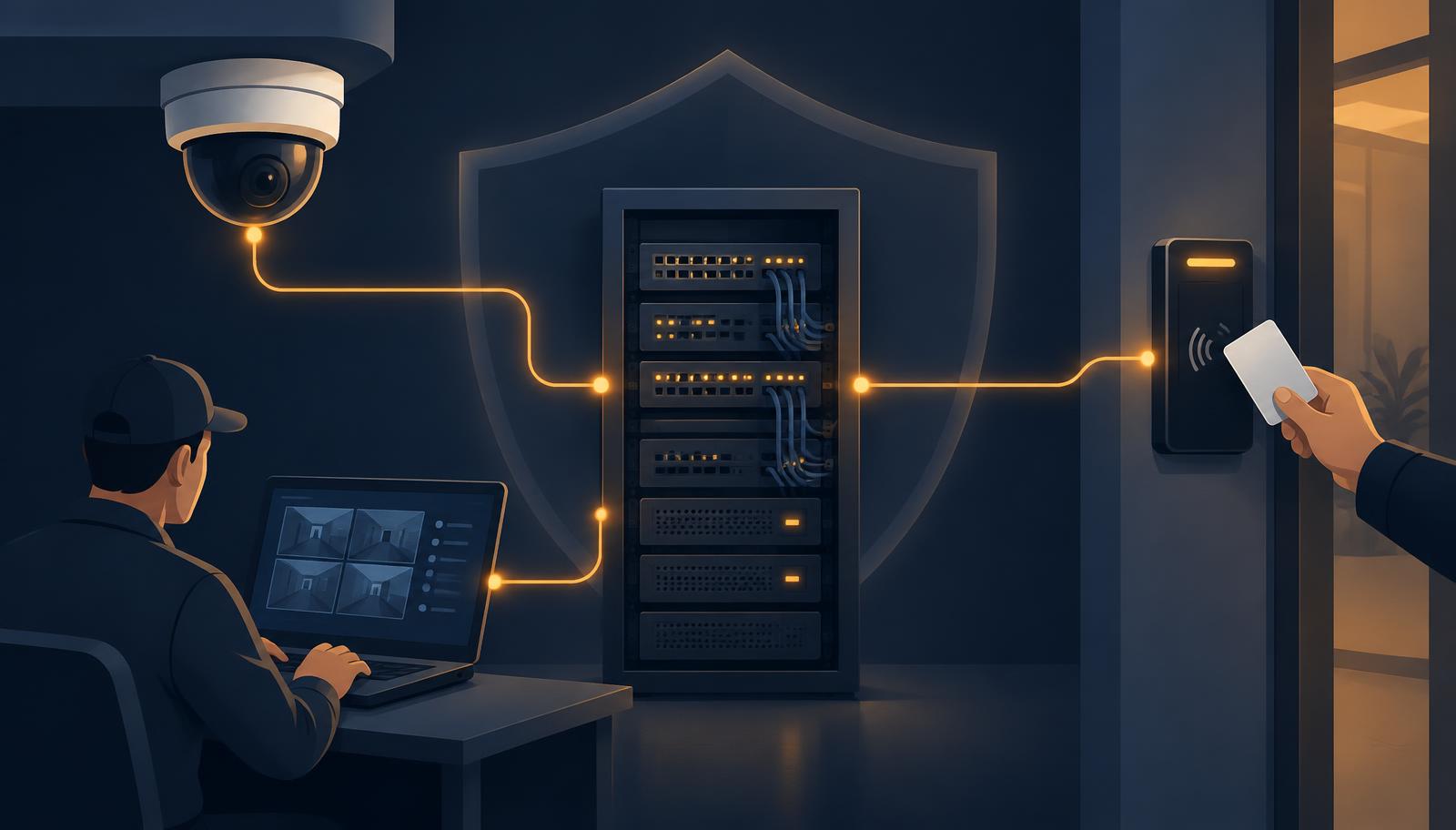
Your crew installs the cameras, configures the access-control system, and sets up remote access so you can troubleshoot without sending a technician to the site.
The installation is complete. The customer is happy. Your team moves on to the next project.
But the connection you created remains.
For a low-voltage contractor, that connection deserves an insurance conversation. Your work can involve customer networks, administrative credentials, connected devices, and ongoing access to systems that control security or support daily operations.
If something goes wrong, the claim may involve both a cybersecurity incident and an allegation that your technology services were performed incorrectly. That is where cyber liability and technology errors and omissions insurance (usually called tech E&O) can overlap.
One incident, more than one insurance question
Consider this hypothetical scenario.
A security integrator installs a camera system at a commercial facility and configures remote access for maintenance. An attacker obtains credentials associated with that access and uses the connection to enter the customer's environment. The customer shuts down affected systems while investigators determine what happened.
The customer later alleges that the integrator failed to restrict remote access appropriately and seeks recovery for business interruption and investigation expenses.
Those allegations do not establish that the contractor caused the incident. But they create several questions:
- Was there a security failure involving access the contractor provided or managed?
- Was the contractor's configuration or support work allegedly negligent?
- Does the contractor's insurance cover the specific services involved?
- Which coverage provisions address the defense and potential liability?
The same event can raise questions about both technology E&O and cyber coverage. Determining what responds requires the allegations, facts, and actual policy wording.
Where cyber exposure enters low-voltage work
A useful review begins with what your technicians do and what access your business retains.
For example:
- Camera and video systems: Do you configure network connections, manage cloud accounts, or retain access to customer footage?
- Access control: Do you administer credentials, user permissions, or systems containing employee and visitor information?
- AV and connected building systems: Do you connect devices to customer networks or provide remote troubleshooting?
- Service and maintenance: Does your team retain administrative access after installation? Who can use it, and when is it removed?
- Structured cabling and network work: Does your scope stop at pulling and terminating cable, or include configuring switches and other network equipment?
Those are different operations with different exposures. A contractor that only installs passive cabling should be described differently from an integrator that configures and remotely manages customer systems.
Your own business also uses email, accounting software, employee records, and project files. The review should consider both your internal systems and the work you perform for customers.
What technology E&O is intended to address
Technology E&O generally addresses claims alleging errors, omissions, or negligence in covered technology products or services that cause financial harm to someone else. Coverage can include defense and covered damages, subject to the policy's terms. The Hartford's technology E&O overview explains this basic purpose.
For a low-voltage contractor, an example might be a customer alleging that incorrect programming caused its system to fail to perform as specified.
The key question is whether the policy's description of covered services includes the work your company actually performs: installation, design, integration, programming, configuration, testing, monitoring, or maintenance.
If you have added remote management or another service since buying the policy, bring that change into the review. A policy selected for an earlier version of your business should be checked against today's operations.
Our guide to general liability and E&O for low-voltage contractors explains how technical-service allegations can create questions beyond a traditional contractor's general liability coverage.
What cyber coverage can address
Cyber insurance can include two distinct types of protection:
| Coverage area | What to review |
|---|---|
| Liability to others | Defense and covered damages arising from certain security failures or privacy incidents. For an integrator, ask specifically how the policy treats allegations involving customer systems and the contractor's access or services. |
| Your business's own losses and expenses | Potential coverage for incident investigation, breach-response services, data restoration, cyber extortion, and business interruption, depending on the coverage purchased and its triggers. |
These protections serve different purposes. A customer's demand for reimbursement is a liability question. Your company's costs after its own covered incident are a separate question.
A cyber policy does not automatically reimburse every loss suffered by a customer. Likewise, having liability coverage does not establish that all of your own recovery expenses are insured. The Hartford's technology E&O and cyber overview distinguishes third-party liability from first-party incident expenses.
Why some carriers combine tech E&O and cyber
Return to the hypothetical remote-access incident. The customer alleges inadequate configuration. The resulting event involves unauthorized network access.
An insurance review needs to consider both parts of that story.
Some carriers offer technology E&O and cyber coverages within the same policy. For example, Travelers describes options for E&O, cyber protection, or both through its CyberRisk Tech product.
A practical reason to consider a combined structure is the opportunity to review overlapping allegations within one coordinated policy. That can be useful when the facts do not fit neatly into a single category.
Still, a combined policy needs careful review. Its coverage sections may have different triggers, exclusions, retentions, and limits. Combining them does not guarantee that a claim is covered.
Separate policies can also form an appropriate program. When coverage is placed separately, ask how the policies fit together if the same event involves both negligent technology services and a security incident.
The objective is to understand how the program addresses your operations before a customer makes a claim.
Seven questions for your next coverage review
Bring your policies, a description of your services, and a representative customer agreement. Then work through these questions with your advisor.
- Are all of our services included? Review installation, configuration, design, monitoring, maintenance, and remote support. Identify any subcontracted services as well.
- How are customer-system incidents treated? Ask the advisor to walk through a scenario involving compromised access to a customer's network, rather than limiting the discussion to a breach of your own office systems.
- What expenses can our business recover after its own incident? Identify the applicable response, restoration, and interruption coverages, along with waiting periods and sublimits.
- Which exclusions could affect our work? Review restrictions involving security systems, monitoring, service failures, contractual promises, and bodily injury or property damage resulting from a technology incident.
- How much limit is actually available? Determine whether E&O and cyber share an aggregate, whether defense expenses reduce it, and which coverages have separate limits or retentions.
- When and how must we report a problem? Review notice requirements, any retroactive dates, and whether insurer approval or designated providers are required for incident expenses. The Hartford's renewal notice illustrates why claims-made reporting terms and defense-cost treatment deserve attention.
- Do our contracts match our insurance program? Compare your actual obligations with the coverage. Our contract and certificate-of-insurance guide explains why a certificate alone cannot resolve a mismatch.
Ask for explanations tied to your work. A list of policy names and limits does not answer these questions.
Practical controls to put alongside the coverage
Insurance should be part of a broader approach to managing access and protecting information.
The FTC's small-business cybersecurity guidance recommends multifactor authentication, software updates, backups, access restrictions, and an incident-response plan. For a low-voltage business, practical applications include:
- Use individual accounts and restrict administrative permissions to people who need them.
- Enable multifactor authentication for remote access and other sensitive accounts wherever supported.
- Replace default passwords and store credentials securely.
- Document responsibility for firmware updates, access changes, and ongoing maintenance.
- Remove access when an employee, subcontractor, or service agreement ends.
- Maintain backups of essential business information and test recovery procedures.
- Keep your insurer's incident-reporting instructions accessible to the people who may discover a problem.
Discuss customer-system controls with the customer's IT team and document responsibilities. Clear handoff records help establish what your company agreed to configure, maintain, and support.
Request a low-voltage cyber and E&O coverage review
Start with four questions: What do you install? What do you connect to? What credentials do you hold? What do you manage remotely?
Those answers provide a useful starting point for reviewing your technology E&O and cyber coverage together.
Low Voltage Insurance, a specialty practice of Insurance Office of America, helps low-voltage contractors and technology integrators review how their insurance programs fit their operations, growth, and customer requirements.
Tell us what you install, connect to, and remotely manage. We'll help review whether your technology E&O and cyber coverage fit those operations.
Request a coverage review or email Jeff Giacobello.
Coverage is subject to underwriting, the terms and conditions of the issued policies, and the facts of each claim. Examples are hypothetical. This article provides general information and is not a quotation, binder, coverage opinion, or insurance contract.