

Who we cover: Access control
Insurance for access control contractors.
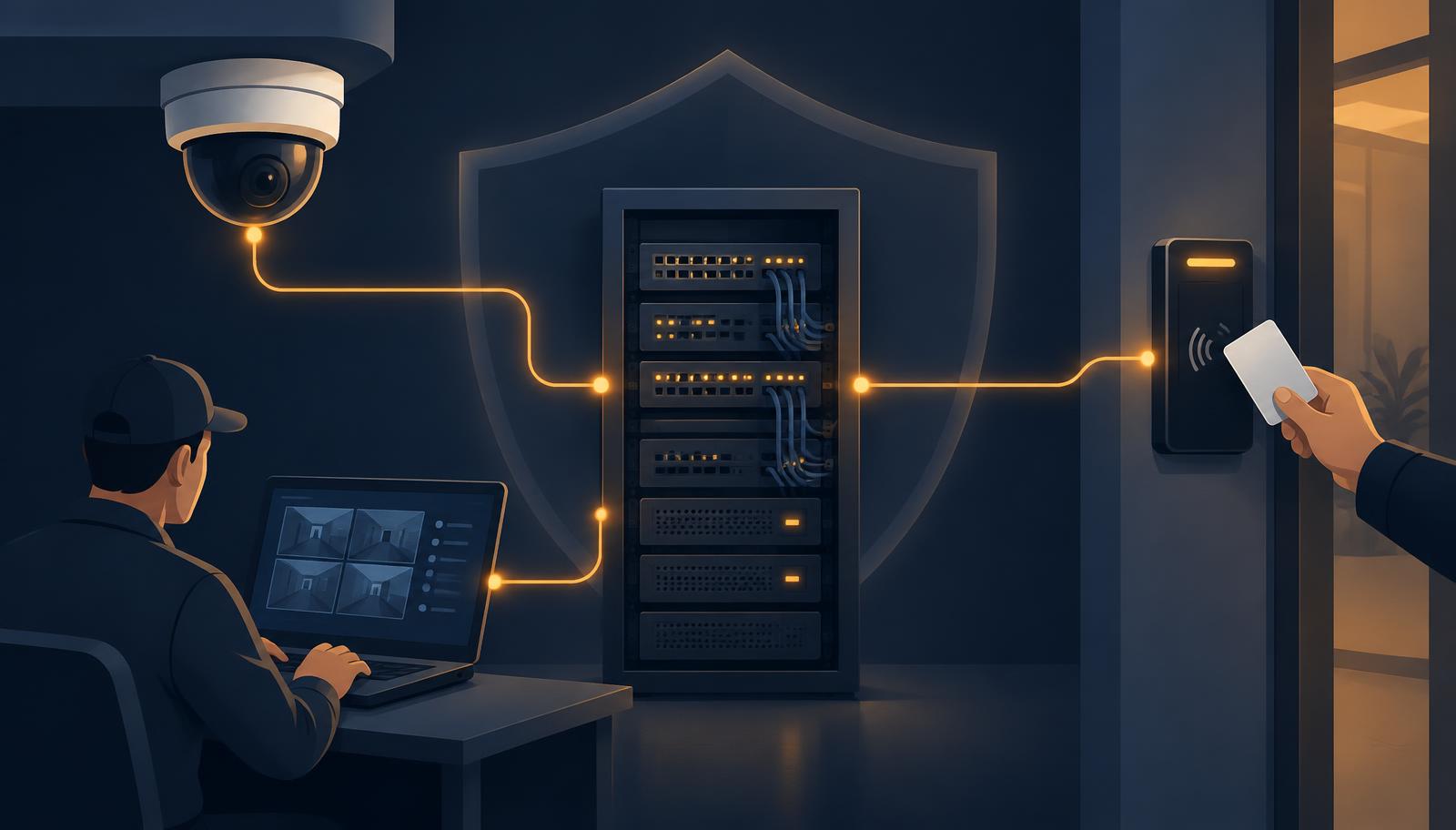
Card and mobile credentials, electrified locking, intercoms, visitor management. Access control decides who gets in and who gets out. When a door does the wrong one, your design, your programming, and your contract all get read.
Where access control risk actually sits.
Access control sits between security and life safety. Claims can come from either side of the door.
Doors that don't release
Life safety codes expect access-controlled egress doors to release on fire alarm and loss of power. A door that stays locked during an emergency is the most serious claim in this trade, and it starts with design, wiring, and programming decisions.
Doors that don't lock
A schedule set wrong, a credential not revoked, or a door left in unlock mode after a service call. When someone walks in who shouldn't have, the customer says the system failed. That's professional liability, and many GL policies exclude it.
Credential and biometric data
Access systems hold names, schedules, and entry logs, and some hold fingerprints or face templates. A few states, Illinois first among them, let individuals sue over biometric data collected without consent, and system vendors have been named in those suits.
Cloud platforms and remote management
Hosted access control and remote programming put your logins on customer systems. A breach that starts with your credentials becomes your claim.
What a claim looks like.
Illustrative example
A contractor installs access control at a two-story medical office, with maglocks on the stairwell doors tied into the fire alarm panel. During a later remodel, an electrician moves the lock power supply. Nobody retests the fire alarm release.
Months later, a small fire sets off the alarm, and the stairwell doors stay locked for several minutes. Two people are hurt getting out another way. Their attorneys name the building owner, the electrician, and the access control contractor, who designed the release and last serviced the doors. The contractor's GL carrier questions whether the design and programming fall under its professional services exclusion.
Coverage built around access control work.
- Professional liability / E&O
- Responds to claims that locking, release, or credential programming was designed or set up incorrectly. Cloud hosting and remote management should be named.
- General liability
- Bodily injury and property damage, including injuries tied to doors and hardware. We check it for professional services exclusions that could shift those claims.
- Cyber
- Breaches of credential databases, cloud platforms, and remote access, plus privacy claims from customers.
- Umbrella
- Life-safety claims can be large, and hospitals, schools, and public owners often require higher limits.
- Tools, equipment, and installation floater
- Controllers, readers, locks, and hardware on site or in transit until the owner accepts the job.
- Workers' compensation
- Classification depends on whether your work is alarm and access installation or broader electrical and door hardware work. We check payroll against what your crews do.
- Commercial auto
- Service vans, plus hired and non-owned auto for techs who drive their own vehicles.
Contract language we read on access control jobs.
- Egress and code responsibility. Who is responsible for code compliance and AHJ approval of locking arrangements, and what happens when others change the system later.
- Data and biometrics. Who owns credential data, who collects consent for biometric readers, and who handles a data request or breach.
- Hosted service terms. Whether your customer agreement passes through the limits and disclaimers your cloud platform gives you.
- Limitation of liability and indemnification. Caps and indemnity language can shift a large share of a life-safety claim, so we check what you're taking on and what your insurance backs.
- Insurance requirements. E&O, cyber, and umbrella limits, additional insured status, and primary and noncontributory wording, checked against your actual policies.
Questions contractors ask
Bodily injury is GL territory, but if the claim is that your design or programming was wrong, a professional services exclusion can come into play. The safest setup is GL without that exclusion for your work, plus E&O that names design and programming.
Often, in part. Codes expect locked egress doors to release on fire alarm and power loss, and the local authority having jurisdiction approves the arrangement. Your contract should say who handles code review and retesting after changes by others.
They can. Some states regulate how fingerprint and face data is collected and stored, and suits have named the vendors as well as the employers. Your contract should put consent on the customer, and your cyber policy should address privacy claims.
Only if the policy says so. Many E&O forms define covered services narrowly. We read the definition against every service you actually sell.
Related reading
 Coverage and claims
Cyber Insurance for Low-Voltage Contractors: Where Tech E&O and Cyber Liability Overlap
How customer networks, remote access, and connected systems create overlapping technology E&O and cyber exposures for low-voltage contractors.
7 minutes readRead article Coverage and claims
General Liability vs. E&O: What Actually Covers a Failed Low-Voltage System
How general liability and technology E&O respond to failed alarm, CCTV, access control, and cabling work, and where coverage gaps hide.
8 minutes readRead article Contracts and compliance
Certificates of Insurance and Contract Requirements: What Low-Voltage Contractors Need Before the Job Starts
What GCs and commercial customers are really asking for when they require a COI, additional insured status, specific endorsements, higher limits, E&O, cyber, and umbrella coverage.
10 minutes readRead article
Find out where your access control program stands.
Book a Risk and Coverage Review. You'll get a one-page findings summary marking each item fits, thin, or gap, with what it takes to fix.