
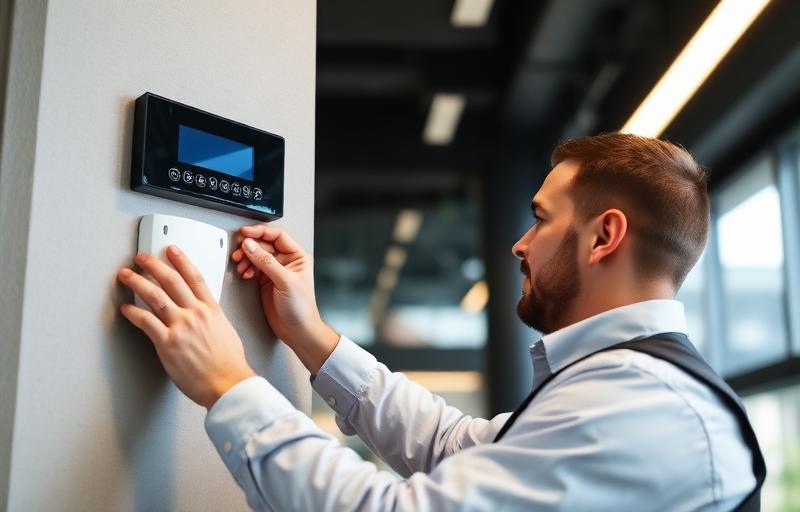
Who we cover: Alarm and security
Insurance for alarm and security contractors.
Intrusion, monitored alarm, panic and duress, interactive services. Your customers pay you so that when something goes wrong, someone knows. When it goes wrong anyway, your contract and your E&O decide who pays.
Where alarm and security risk actually sits.
Most claims against alarm contractors don't start with an injury on a job site. They start with a loss the system was supposed to stop.
Failure to signal or respond
A burglary, a hold-up, or a break-in nobody heard about. The customer, or their property insurer, says the system didn't work or nobody acted on it. That's a professional liability claim, and GL often won't respond.
Monitoring you don't run yourself
If you resell a third-party central station, your customer's contract is with you. Your agreement with the customer needs to line up with the central station's agreement with you, or the gap sits on your balance sheet.
Access to customer premises
Your techs know alarm codes, layouts, and when buildings are empty. If an employee steals from a customer, most GL and property policies won't cover it. That's a crime coverage question.
Remote access and interactive services
Apps, cloud panels, and remote programming put your logins on customer systems. A breach that starts with your credentials becomes your claim.
What a claim looks like.
Illustrative example
A contractor services the intrusion system at a retail store. During a service call, a tech bypasses a rear door contact to finish a repair and forgets to restore it. Three weeks later, thieves come in through that door overnight and take a large share of the store's inventory. No alarm reaches the central station.
The store's insurer pays the claim, then sues the contractor. The contractor's standard agreement caps liability at a small fixed amount, but this customer signed an older version without the cap. The GL carrier treats the bypass as a professional services issue.
Coverage built around alarm and security work.
- Professional liability / E&O
- Responds to claims that a system was designed, programmed, serviced, or monitored incorrectly. Monitoring and interactive services should be named, not assumed.
- General liability
- Bodily injury and property damage on job sites. We check it for professional services exclusions and alarm-specific limitations.
- Third-party crime
- Covers theft of customer property by your employees, which GL and property policies generally don't.
- Cyber
- Breaches that start with your remote access, apps, or cloud-managed panels, including claims from customers.
- Umbrella
- Commercial, bank, and public customers often require limits above the primary policy.
- Workers' compensation
- Alarm installation has its own classification in many states. Payroll rated as general electrical work is a common audit finding.
- Commercial auto
- Service vans, plus hired and non-owned auto for techs who drive their own vehicles.
Contract language we read on alarm and security jobs.
- Limitation of liability. Courts have upheld caps in the hundreds or low thousands of dollars on losses many times larger. Most states won't extend them to gross negligence, and they only help if they're in the version your customer signed.
- Waiver of subrogation. It can stop the customer's insurer from pursuing you after a burglary or fire loss.
- Third-party central station terms. Whether your customer agreement passes through the same limits and disclaimers the central station gives you.
- Indemnification. Broad-form language can make you responsible for losses you didn't cause. We check whether your insurance actually backs what you promised.
- Insurance requirements. E&O limits, crime coverage, additional insured status, and primary and noncontributory wording, checked against your actual policies.
Questions contractors ask
Usually not. The claim is that your system or service failed, which is professional liability. GL is built for bodily injury and property damage you cause, and many GL forms exclude professional services outright.
No. Courts in most states enforce these clauses for ordinary negligence, but you still have to defend the suit to get there, and many states won't apply them to gross negligence. E&O pays for that defense.
Yes. Your customer contracts with you, so the claim comes to you first. What matters is whether your agreement with the customer matches the protections the central station gives you, and whether your E&O names monitoring as a covered service.
Not under most GL or property policies. Third-party crime coverage, sometimes called client's property coverage, is built for that. Some commercial customers require it in their contracts.
Related reading
 Coverage and claims
General Liability vs. E&O: What Actually Covers a Failed Low-Voltage System
How general liability and technology E&O respond to failed alarm, CCTV, access control, and cabling work, and where coverage gaps hide.
8 minutes readRead article Coverage and claims
Cyber Insurance for Low-Voltage Contractors: Where Tech E&O and Cyber Liability Overlap
How customer networks, remote access, and connected systems create overlapping technology E&O and cyber exposures for low-voltage contractors.
7 minutes readRead article Contracts and compliance
Certificates of Insurance and Contract Requirements: What Low-Voltage Contractors Need Before the Job Starts
What GCs and commercial customers are really asking for when they require a COI, additional insured status, specific endorsements, higher limits, E&O, cyber, and umbrella coverage.
10 minutes readRead article
Find out where your alarm program stands.
Book a Risk and Coverage Review. You'll get a one-page findings summary marking each item fits, thin, or gap, with what it takes to fix.