
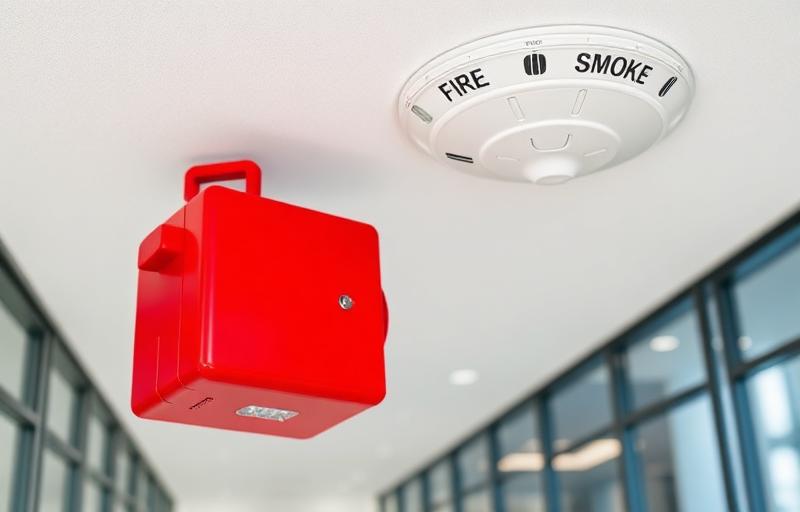
Who we cover: Fire alarm
Insurance for fire alarm contractors.
Design, installation, inspection and testing, monitoring. When a building burns, every one of those turns into a question about what your system did. We build programs where the answer lands on a policy.
Where fire alarm risk actually sits.
Fire alarm work carries a different kind of exposure than most low-voltage trades. The loss isn't the panel. It's the building.
Failure to detect or notify
When a fire spreads, the owner's property insurer looks at the alarm system next. A claim that a detector, panel, or notification path didn't work is often treated as a professional liability claim, and many GL policies exclude it.
Inspection and testing
NFPA 72 sets inspection, testing, and maintenance requirements, and owners often hand that work to a contractor under a written agreement. Your inspection reports become evidence. A missed device or a vague report can tie you to a loss years later.
Design and programming
Device layout, panel programming, and sequence of operations are design decisions. A GL policy written for installation work may not respond when the complaint is that the design was wrong.
Monitoring and service agreements
If you monitor, or resell monitoring, your contract decides how much of a loss you carry. Limitation of liability and waiver of subrogation clauses do real work here, but only if they're in the version your customer signed.
What a claim looks like.
Illustrative example
A contractor installs and inspects the fire alarm system in a three-story office building. Eighteen months after the last annual inspection, a fire starts overnight in an electrical room. The building is heavily damaged.
The property carrier pays the owner, then files a subrogation suit against the contractor. It alleges a detector in that room wasn't working and the inspection report didn't catch it. The contractor's GL carrier points to its professional services exclusion. With no E&O in place, the defense and any settlement come out of the business.
Coverage built around fire alarm work.
- Professional liability / E&O
- Responds to claims that your design, programming, inspection, or monitoring failed. Every service you sell should be named as a covered service.
- General liability
- Bodily injury and property damage on job sites. We check it for professional services exclusions and endorsements that narrow it for alarm work.
- Umbrella
- Owners and GCs on larger jobs often require limits above the primary policy. A fire loss can run past them too.
- Workers' compensation
- Alarm installation has its own classification in many states. Payroll rated as general electrical work is a common audit finding.
- Tools, equipment, and installation floater
- Panels, devices, and wire on site or in transit until the owner accepts the job.
- Commercial auto
- Service vans, plus hired and non-owned auto for techs who drive their own vehicles.
- Cyber
- Panels and monitoring platforms that connect to customer networks or the cloud.
Contract language we read on fire alarm jobs.
- Limitation of liability. Courts in most states enforce these for ordinary negligence, and many won't for gross negligence. It only helps if it's in the version your customer signed.
- Waiver of subrogation. It can stop the owner's property insurer from coming after you following a fire. Some courts have enforced these even when the insurer alleged gross negligence.
- Indemnification. Broad-form language can make you responsible for losses you didn't cause. We check whether your insurance actually backs what you promised.
- Inspection scope. What you agreed to test, how often, and what happens when the owner declines a repair you recommended.
- Insurance requirements. E&O limits, additional insured status, and primary and noncontributory wording, checked against your actual policies.
Questions contractors ask
Often not fully. Many GL policies exclude professional services, and a claim that a system was designed, programmed, or inspected incorrectly is usually treated as professional liability. That's why fire alarm contractors need E&O that names those services.
Usually, yes. Design, programming, and inspection all carry professional exposure, even without monitoring. Monitoring adds more, and the contract you use for it matters.
Most often the building owner's property insurer, through subrogation. After it pays the owner, it can pursue anyone whose work may have contributed. A waiver of subrogation in your contract can limit that.
NFPA 72 sets inspection, testing, and maintenance frequencies, and your local authority having jurisdiction enforces them. Many devices are tested annually. Your agreements should state exactly what you test and when.
Related reading
 Coverage and claims
General Liability vs. E&O: What Actually Covers a Failed Low-Voltage System
How general liability and technology E&O respond to failed alarm, CCTV, access control, and cabling work, and where coverage gaps hide.
8 minutes readRead article Contracts and compliance
Certificates of Insurance and Contract Requirements: What Low-Voltage Contractors Need Before the Job Starts
What GCs and commercial customers are really asking for when they require a COI, additional insured status, specific endorsements, higher limits, E&O, cyber, and umbrella coverage.
10 minutes readRead article Coverage and claims
Installation Floater vs. Tools and Equipment: What Covers Materials Before They're Installed?
Where cameras, panels, cable, and other project materials may be covered while in transit, staged at a job site, and awaiting final acceptance.
9 minutes readRead article
Find out where your fire alarm program stands.
Book a Risk and Coverage Review. You'll get a one-page findings summary marking each item fits, thin, or gap, with what it takes to fix.